
Applications
Glass Marbles for Board Games: Set Counts, Colour Sorting and Retail Packing
How many marbles a Chinese checkers or solitaire set actually needs, why colour sorting drives your unit cost, and which retail packing formats work for game sets.
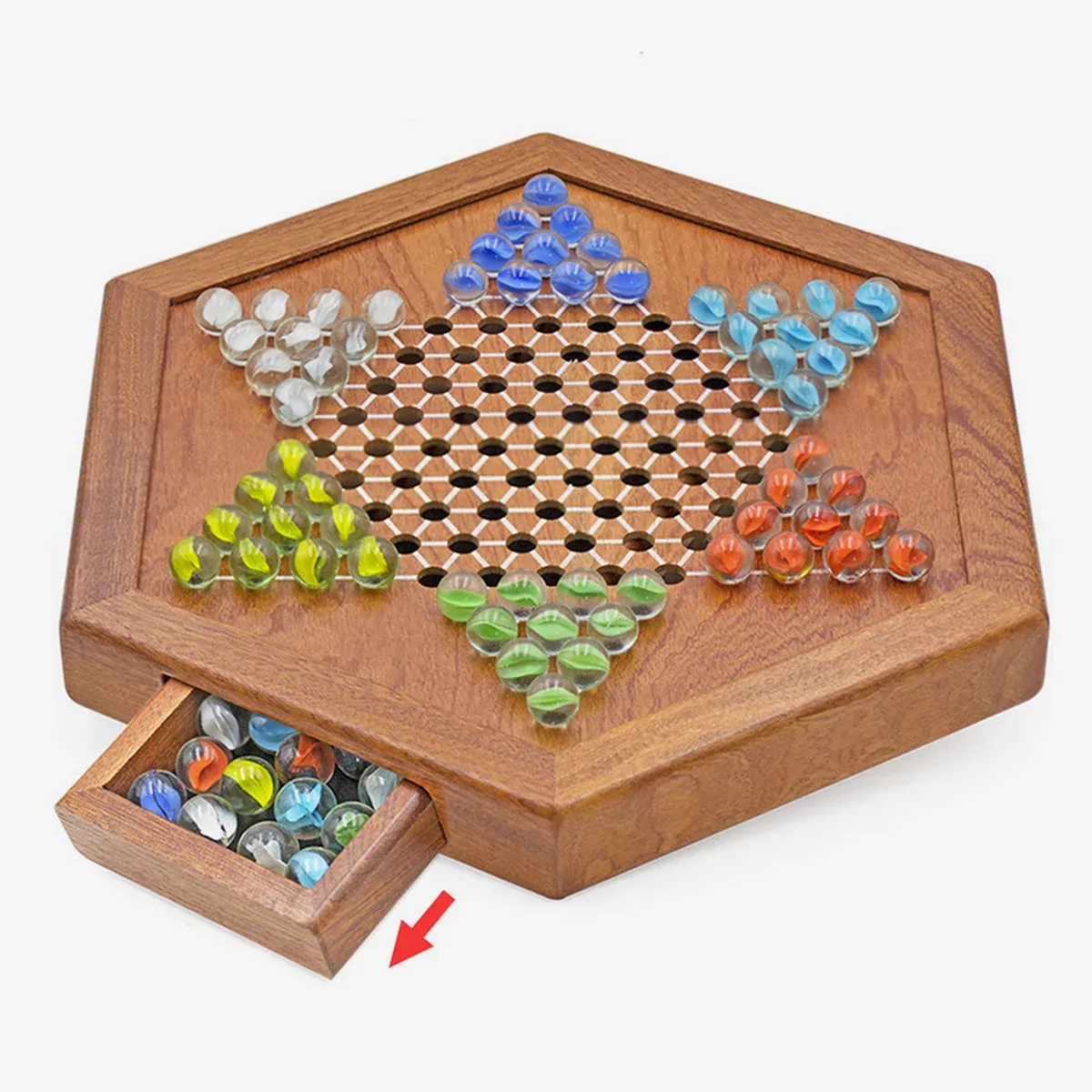
A standard six-player Chinese checkers set needs 60 marbles — ten per player across six colours — and a marble solitaire board needs 32 plus one empty hole. SunWard Products Co., Ltd. produces the glass marbles for both from 9 mm to 35 mm at our factory in Zibo, Shandong, and supplies game and toy brands with sorted sets rather than loose bulk. The two numbers that decide your unit cost are the count per set and the colour split, not the marble price itself. This guide covers both, plus the retail packing formats that survive a game-box drop test.
How many marbles each game format needs
Count first, then price. Chinese checkers on a standard 121-hole star board uses 10 marbles per player and supports two to six players, so a retail set is either 20 marbles (two-player) or the full 60 (six-player). Marble solitaire on the English 33-hole board uses 32 marbles plus one vacant hole. A 35 mm showpiece set uses far fewer pieces but a much larger diameter, which changes the carton weight more than the piece count suggests.
Add a spare allowance to whatever count you specify. End users lose marbles, and a set that cannot be completed after one loss generates returns. A typical allowance is 2–5% over the board count, packed into the box rather than shipped separately.
Colour sorting is the part that decides your unit cost
Colour sorting, not moulding, is the labour step in a game-set order. Loose bulk marbles come off the line mixed, and producing six exact colour groups of ten requires either a sorting run or a production run per colour. That is why a 60-piece sorted set costs more per marble than 60 loose marbles of the same size, and why the colour split you specify has a direct effect on price.
Practical advice: keep the colour count low, use the standard six colours that players expect, and accept mixed-pattern marbles in the non-playing positions if the game does not depend on them. If your set uses printed or cat's eye marbles where the pattern varies, agree the acceptable variation against a sample rather than by description.
Retail packing formats that suit game sets
Four formats cover most game-set orders: net bag with header card at 50–500 pcs for hangable impulse retail, PVC bag at 250 g–2 kg for bagged sets, paper or PVC box for boxed games that need a printed sleeve, and a display box where the set is sold from a counter. The packing must hold the full sorted set in one unit — split packing defeats the purpose of sorting.
Weight matters here. A 60-piece 16 mm set is roughly 300–350 g of glass before packing, so a hangable card has to be rated for that load. Confirm the packed weight per unit with the supplier before committing to a card format, because a header card that tears in transit is the most common game-set packing failure.
Ordering a game-set run: four inputs
Four inputs make a game-set quotation comparable: (1) piece count per set and colour split; (2) diameter and finish for each marble in the set; (3) packing format and packed weight per unit; (4) total number of sets, and therefore total tonnage. Give all four and the quotation becomes checkable against another supplier line by line.
SunWard's minimum order is 1 ton, payment T/T, shipping worldwide, and popular sizes are held in stock. A 1 ton order is roughly 170–200 six-player sets at 16 mm, depending on spare allowance and packing weight — which makes a 1 ton trial a realistic first production run for a game brand.
FAQ
How many marbles are in a Chinese checkers set?
A six-player set uses 60 marbles, ten per player across six colours, on a standard 121-hole star board. Two- and three-player sets use 20 and 30 respectively. Add a small spare allowance so the set can still be completed if a player loses a marble.
How many marbles does a marble solitaire board need?
An English 33-hole solitaire board uses 32 marbles plus one empty hole to start. French 37-hole boards use 36. Solitaire sets are usually sold with a single colour, which removes the colour-sorting cost and makes them cheaper per set than a multi-colour game.
Why is a sorted set more expensive than loose marbles?
Because colour sorting is a separate labour step. Loose marbles come off the line mixed, so producing six exact groups of ten requires either a sorting run or a dedicated production run per colour. Fewer colours and a looser pattern specification both reduce that cost.
What is the minimum order for game-set marbles?
Minimum order is 1 ton, which is roughly 170–200 six-player sets at 16 mm depending on spares and packing weight. Popular diameters are held in stock, so a 1 ton trial can ship without waiting for a production slot. Payment is by T/T.