Applications
Decorative Glass Marbles for Games, Vases and Aquariums: Five Failures to Specify Out Before a Bulk Order
Games fail on chips, vase decoration fails on neck diameter, aquariums fail on dyed coatings. How to specify decorative glass marbles for each use, and why tolerance decides most of it.

Decorative glass marbles are bought for three jobs that fail in three different ways: game sets fail on chips and sharp edges, vase and planter decoration fails when the marble will not pass the vessel opening, and aquarium use fails when a dyed or coated surface starts releasing colour into the water. SunWard Products Co., Ltd. manufactures decorative glass marbles in Zibo, Shandong, China — 100% glass, polished, 9–35 mm, held to a ±0.1–0.2 mm diameter and roundness tolerance — and this guide covers how to specify each of the three uses so the shipment does not come back.
What actually varies between decorative marble lines
Four attributes decide whether a decorative marble suits a job: diameter, finish, whether the colour is in the glass or on it, and the tolerance band. Diameter ranges 9–35 mm and sets the maximum vessel opening the marble will pass. Finish is one of five — clear, solid colour, cat's eye (2, 3, 4 or 8 petals), opaque ceramic-look, and speckled sesame. Colour-in-glass is what makes a marble safe for water; a dyed or surface-coated marble is a different product with different risks. The tolerance band, ±0.1–0.2 mm on both diameter and roundness, decides whether game pieces roll true and whether a decorative layer sits evenly.
Price differences between two quotes for "16 mm decorative marbles" almost always sit in one of these four, not in the glass itself. Establish all four before comparing numbers.
Kids game sets: the chip problem and how to specify around it
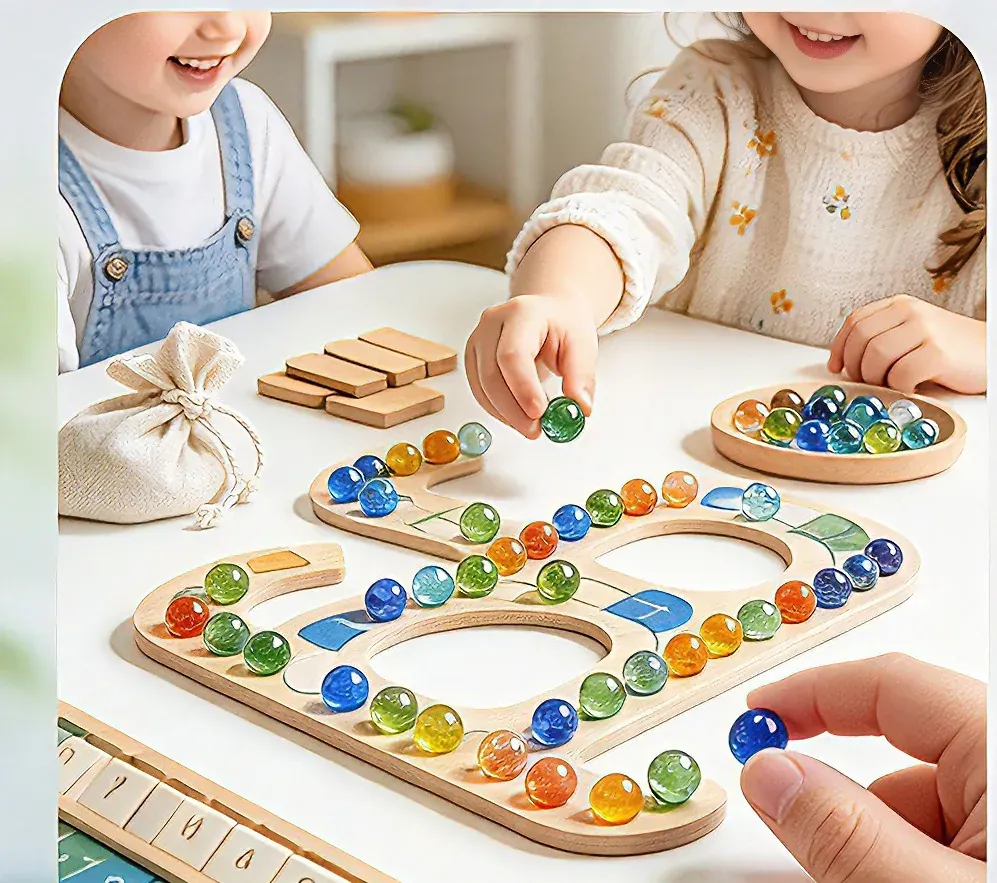
Specify zero tolerance for chipped or cracked pieces, and ask how the supplier screens for them. A chipped marble is a sharp point, and in a toy channel a sharp point is a safety issue rather than a cosmetic defect. SunWard's marbles are 100% glass, polished, and screened before packing; the factory is BSCI audited and the marbles are tested to EN71-1 (mechanical and physical properties), EN71-2 (flammability) and EN71-3 (migration of certain elements).
The second failure in game sets is size inconsistency. A set that mixes noticeably out-of-round pieces will not sit flat in the board and gets returned by the end user, not by your QC team. The ±0.1–0.2 mm diameter and roundness tolerance is the number to put in the purchase order, together with a retained approved sample.
The third is count and colour split. A six-player Chinese checkers set needs 60 marbles in six colour groups; producing sorted groups is a separate labour step from moulding, which is why a sorted set costs more per marble than the same marbles sold loose. Keep the colour count low and agree the mix in writing.
Vase and planter decoration: the neck diameter decides your order
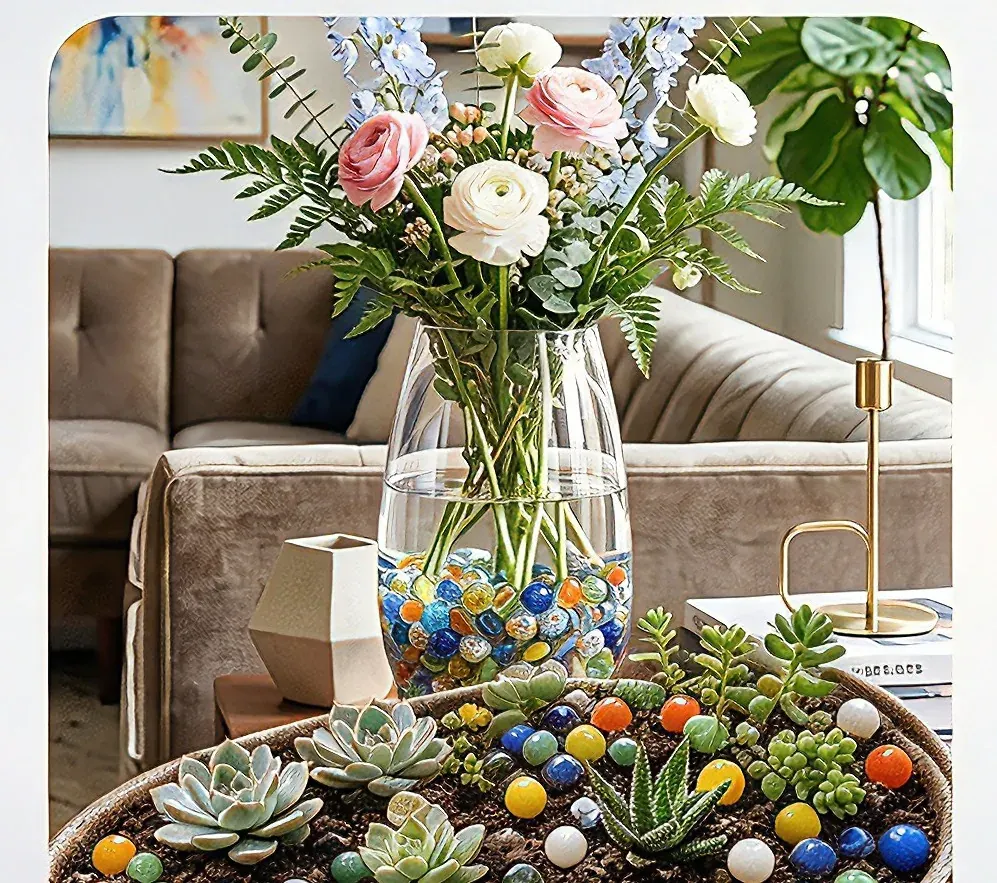
Measure the vessel opening before choosing the marble, because the neck — not the body — sets the maximum size you can use. A 25 mm marble will not pass a 20 mm neck, and a customer who orders the wrong size has a decoration they cannot install. The practical mapping is: 9–12 mm for narrow-neck vases and small bud vases; 13–16 mm as the general decor size for standard vases and planter top dressing; 19–25 mm for wide bowls and larger arrangements; 35 mm for showpiece pieces in open vessels.
The second specification point for decor is opacity. A clear marble disappears against a busy background — soil, printed glass, coloured water — while an opaque or speckled marble holds its colour and reads as a solid design element. That is the reason the ceramic-look and sesame finishes exist in the range.
The third is colour consistency between batches. Colour is formed inside the glass rather than printed on it, so exact reproduction across separate production runs is not guaranteed. The workable control is a retained approved sample held against each lot, confirmed before the order is placed rather than after delivery.
Aquarium use: which marbles are safe and which are not
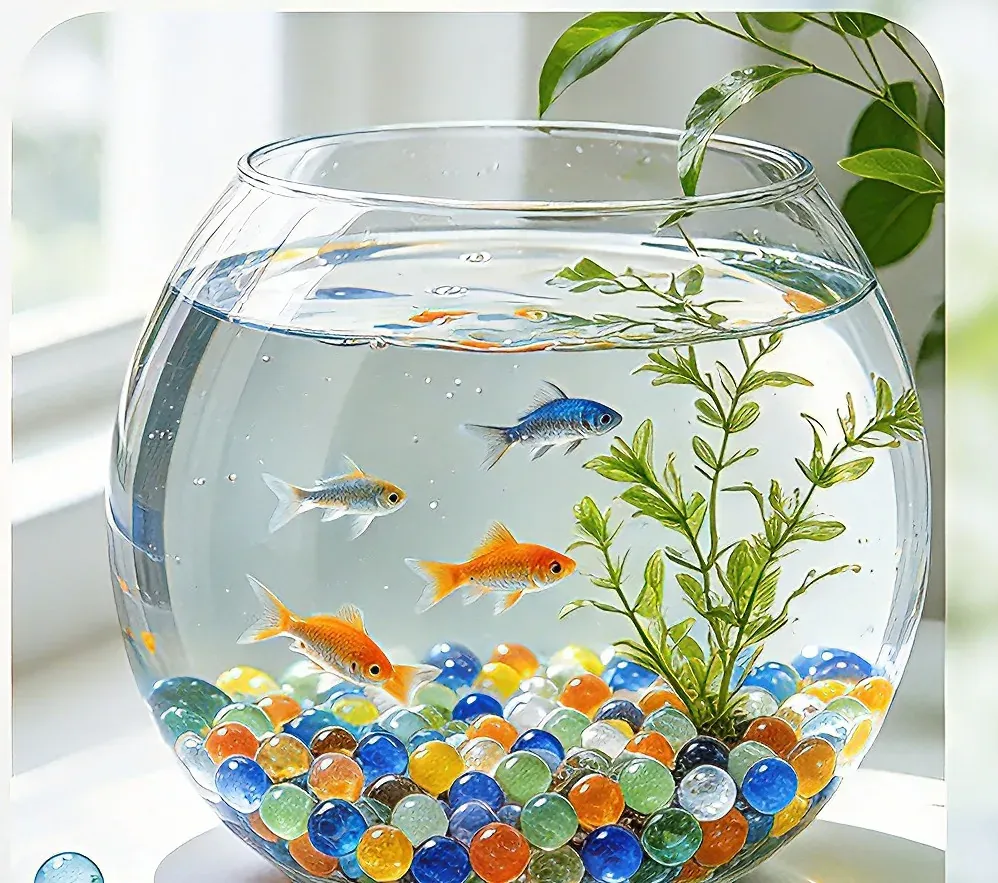
Uncoated glass is inert in freshwater and does not raise pH or release anything into the water column, so plain glass is safe as aquarium substrate. The risk is the dye or the surface coating, not the glass. For aquarium use, specify uncoated glass with the colour formed inside the material: SunWard's range, including the opaque and speckled finishes, is 100% glass with no surface coating applied.
Screen a sample before you fill a tank. Soak a handful in tank water for 48 hours and check the water stays clear with no colour shift or film; rub two marbles together and look at the contact point, because a coated marble scuffs and shows a lighter core; check the edges under bright light for chips, since a chipped marble is a hazard to bottom feeders; and confirm in writing that the product is uncoated. The 48-hour soak is the check that matters — it catches the failure no specification document shows.
Size for the tank rather than the look: 9–16 mm reads as gravel, 19–25 mm reads as individual decorative objects, and 35 mm reads as a single showpiece. For tanks with shrimp or bottom feeders, prefer the smaller end and reject chipped pieces.
Packing a decorative range for retail
A decorative range is usually sold in small units, so the packing format costs more per unit than the marble does. Four formats cover most decorative orders: net bag with header card at 50–500 pcs (hangable, for impulse retail), PVC bag at 250 g–2 kg (bagged sets), glass jar or PET barrel for the gift channel, and paper or PVC box for a printed retail sleeve. All twelve formats in the range can carry OEM artwork, a private label or a custom header card.
Two packing failures are worth designing out in advance. A header card that tears in transit is the most common failure in hangable decorative packs, so confirm the packed weight per unit against the card rating before committing. And a mixed-pack assortment needs the ratio fixed in writing, because the ratio changes both the carton count and the packing cost more than the marble price does.
Getting a comparable quotation
Send six things and the quotation becomes checkable line by line: (1) the end use — games, decor or aquarium; (2) diameter and the tolerance band; (3) finish and colour or pattern reference; (4) quantity, or the piece count per set if you are packing sets; (5) the packing format and destination market; (6) the destination port. With those six, a supplier either quotes a comparable price or reveals which one they cannot meet.
SunWard's terms: minimum order 1 ton, production lead time typically 7–15 days with popular sizes shipping from stock sooner, payment by T/T, and worldwide shipping with export packing from our own yard. Where a specification has to match an existing product, send a physical sample and we confirm the closest production match before quoting.
To start a quotation, write to info@sunwardproducts.com or theozeng@sunwardproducts.com, or call and message +86 158 7521 8060 on WhatsApp. Send the six points above with a photo of the vessel, board or tank you are supplying, and we will reply with the closest match, the packing options and a price. The factory is in Zibo, Shandong, China, and we answer Monday to Saturday, 8:30–18:00 GMT+8.
FAQ
Are decorative glass marbles safe for aquariums?
Uncoated glass marbles are safe: glass is inert in water and does not raise pH or release anything into the water column. The risk is dyed or surface-coated marbles, where colour can flake or leach. Specify uncoated glass with the colour formed inside the material, and run a 48-hour soak test on a sample before filling a tank.
What size decorative marbles suit a vase?
Measure the vase neck first, because the opening — not the body — limits the size. Use 9–12 mm for narrow-neck and bud vases, 13–16 mm for standard vases and planter top dressing, 19–25 mm for wide bowls, and 35 mm for showpiece pieces in open vessels.
Why do decorative marbles cost more than plain ones?
The colour or pattern and the sorting are the extra labour, not the glass. A patterned marble needs a separate production setup, and a decor range that mixes several colours requires sorting. A single-colour bulk order costs less per marble than a multi-colour assorted pack of the same size.
Can you print our own label or header card?
Yes. All twelve packing formats can carry OEM artwork, a private label or a custom printed header card, and mixed-pack assortments can be built to a ratio you specify. Send the design file and the target format, and confirm the packed weight per unit against the card rating before production.